
The Marion County Inmate Population
The Marion County inmate population is held mainly at the Marion County Jail, run by the Marion County Sheriff's Office Detention Bureau. The bureau describes its job as the care, custody, and control of everyone incarcerated at the jail. That includes people awaiting trial, people serving short county sentences, and people waiting to be moved to another county, a city facility, or state prison. The Detention Bureau says its Custody and Security Division handles roughly 1,600 to 1,700 inmates on a working basis and runs four shifts around the clock.
The county arrests that feed this count do not all come from the Sheriff's Office. The jail books people brought in by the Ocala Police Department, Dunnellon Police, Belleview Police, the Florida Highway Patrol, the Department of Transportation, the Fish and Wildlife Conservation Commission, the U.S. Marshals Service, and other agencies working in the county. The size of the population rises and falls with arrests, bond decisions, court schedules, and transfers to the Florida Department of Corrections after sentencing.
Marion County's setup is unusual. Four state prisons sit inside the county along with the jail, so the words "Marion County inmate" can point to two very different systems. A pretrial detainee shows up on the county jail roster. A sentenced state prisoner shows up in the state corrections locator. That split matters on every page below.
The Marion County Sheriff's Office posts its detention work, booking, and inmate services through its public site. The detention page is a good place to confirm that the jail in Ocala is the countywide booking point.
To picture how the county describes its own operation, the Sheriff's Office Detention Bureau page lays out the bureau structure and population range in plain terms. See the MCSO Detention Bureau page for the source.
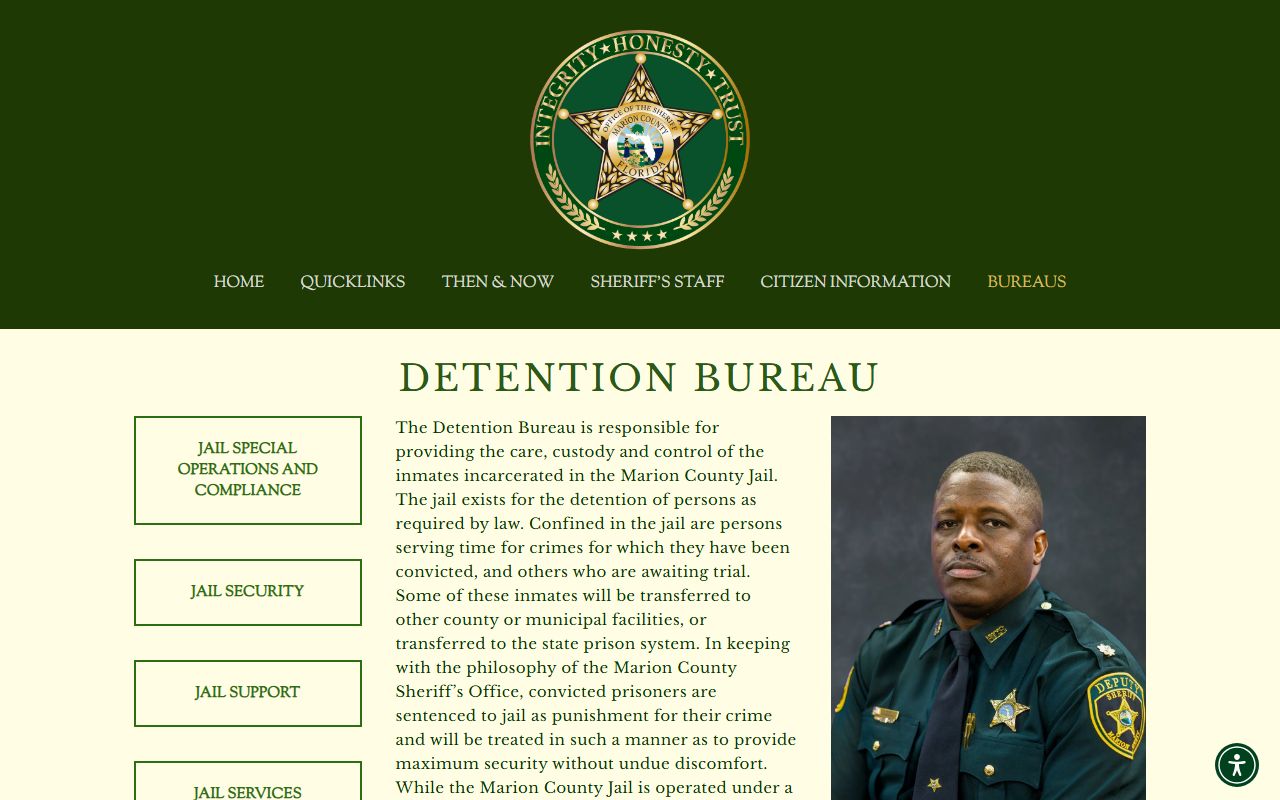
The detention overview confirms the 1,600 to 1,700 working count and the four around-the-clock shifts that keep the Marion County inmate population housed and processed every day of the year.
Marion County Inmate Population Statistics
The strongest numbers for the Marion County jail population come from the Sheriff's Office Detention Bureau Annual Report for 2024 and from the Florida Department of Corrections monthly county detention reports. The jail's rated capacity is 1,924 beds across 10 adult housing units. Its 2024 average daily population was 1,822, and the peak that year reached 1,922, just two beds under capacity.
The figures below are each tied to a named source and year. The county jail count and the statewide prison count are kept separate on purpose, because a single combined number would blur two systems that the public should treat differently.
| Measure | Figure | Source / Year |
|---|---|---|
| Average daily population | 1,822 | MCSO Detention Bureau Annual Report, 2024 |
| Rated / bed capacity | 1,924 beds | MCSO Detention Bureau Annual Report, 2024 |
| Peak population | 1,922 | MCSO Detention Bureau Annual Report, 2024 |
| Inmate admissions | 783 | FLHealthCHARTS, generated 2026 |
| Incarceration rate | 3.4 per 1,000 residents | FDC County Detention report, Oct 2025 |
The FLHealthCHARTS admissions figure is a health-statistics measure of people admitted, not the same thing as total jail bookings, so it is labeled as its own count. Marion County's incarceration rate of 3.4 per 1,000 residents sat near the middle of Florida counties in the fall of 2025.
Marion County Inmate Population Trends
The Marion County inmate population has not held steady. The Sheriff's annual report shows the jail's average daily population rising from 1,719 in 2023 to 1,822 in 2024. The Florida Department of Corrections monthly reports then show lower counts during 2025, with 1,604 in March and 1,430 in October. Monthly snapshots are not full-year averages, so the dip should be read as a point-in-time reading rather than a settled decline.
| Year / Month | Average Daily Population | Notes |
|---|---|---|
| 2023 | 1,719 | MCSO annual report comparison year |
| 2024 | 1,822 | MCSO annual report; peak 1,922 |
| March 2025 | 1,604 | FDC monthly report; 55.7% pretrial |
| October 2025 | 1,430 | FDC monthly report; 54.9% pretrial |
One trend holds across every report. More than half the people in the jail are pretrial, meaning they are held while their cases are pending and have not been convicted. That share stayed above 54 percent through 2025. The county's own resident population is also climbing fast, from 375,908 in the 2020 Census to an estimated 442,660 by July 2025, which is worth noting alongside the jail counts without assuming one caused the other.
Who Makes Up the Marion County Inmate Population
The 2024 annual report breaks the jail population down by sex, charge level, and race. The averages show a population that is mostly male and mostly held on felony charges. The FDC monthly reports add a pretrial breakdown that the annual report does not.
- Pretrial vs sentenced - In October 2025, 785 of the 1,430 inmates were pretrial (54.9 percent), split between felony and misdemeanor holds.
- Male vs female - The 2024 averages were 1,503 male and 319 female.
- Felony vs misdemeanor - Among men, 1,353 were felony and 150 misdemeanor; among women, 271 felony and 48 misdemeanor.
- Race - The 2024 report listed the population as 64.6 percent White, 34.91 percent Black, and 0.49 percent other.
These categories come from different reports and should not be merged into one made-up table. The Sheriff's annual report counts averages by sex and charge level; the state monthly reports count pretrial status. Each is accurate on its own terms.
Marion County Jail Capacity and Growth
The Marion County Jail opened in December 1985 with 384 beds. Double-bunking was approved in 1987 and raised the count to 664. Later work pushed capacity to 888 in 1990, 1,112 in 1992, and 1,504 after worker barracks were added. A larger expansion reached 2,164 in January 2007 and 2,180 in 2009. The current maximum became 1,924 beds as of July 1, 2018.
Run against that capacity, the 2024 average daily population of 1,822 worked out to roughly 95 percent of the rated beds, and the annual peak of 1,922 effectively filled the jail. The 2025 monthly readings ran lower, which eased the squeeze but did not change the basic picture of a jail that operates close to its limit in busy years.
The annual report also records the jail's standing on conditions. It was inspected on March 14, 2024 and found compliant with all serious and notable Florida Model Jail Standards, and it was inspected again on April 9 through 11, 2024 and recommended for reaccreditation with excelsior status by the Florida Corrections Accreditation Commission. Separately, news outlets have reported lawsuits against the Sheriff's Office. One federal suit reported by WCJB alleged 29 in-custody deaths between 2021 and 2024 and 599 use-of-force incidents in 2024. Those figures come from litigation allegations, not from a court finding or the annual report, and remain disputed.
Laws Governing the Marion County Inmate Population
A handful of Florida laws make the jail population public and set the rules the jail runs under. Public-records law opens the underlying records, the jail-standards law sets minimum conditions, and a federal grant program drives death-in-custody reporting. The booking-photo law on commercial publishers is covered on the mugshots page.
Key Statutes:
Florida Statutes § 119.01 - State, county, and municipal records, including jail and booking data, are open for inspection and copying by any person.
Florida Statutes § 951.23 - Each county detention facility must meet at least the Florida Model Jail Standards covering density, bedding, food, medical care, classification, and inspection.
FDLE Death in Custody Reporting - Agencies receiving certain federal grant funds report custody deaths to FDLE on a quarterly basis.
The Florida Model Jail Standards are the rulebook inspectors use, and the annual report points to them as the basis for the jail's compliance finding.
Marion County and the State Prison Population
When a person from Marion County is convicted and sentenced to more than a year, custody usually moves from the county jail to the Florida Department of Corrections. Four FDC prisons sit inside the county itself: Lowell Correctional Institution and Lowell Annex hold women, the Florida Women's Reception Center is a multiple-mission women's facility, and Marion Correctional Institution holds men. Their listed capacities add up to thousands of beds, separate from the jail's 1,924.
Because those prisons are in the county, some people assume the county jail roster covers them. It does not. A sentenced state prisoner is searched through the FDC offender locator, not the Sheriff's jail search. The reception center even processes some women sentenced elsewhere in Florida, so a person can pass through Marion County state custody without ever having a Marion County criminal case.
How to Search the Marion County Inmate Population
The Sheriff's Office points the public to an official inmate search that opens the county jail roster. The link sits on the MCSO site and routes to the jail portal. During research the portal returned a blocked response to automated tools, so the exact on-screen fields could not be confirmed, but the official path and the phone fallback are documented.
Before starting, have the person's full name ready, and a date of birth if you have it. The roster covers people currently in the county jail, so a sentenced or transferred person may need a different system.
- Open the MCSO inmate search page and follow its link to the jail roster.
- Try the official roster portal at jail.marionso.com in a normal browser and search by last name.
- If the portal does not load or does not return the person, call the jail at 352-351-8077 for current-inmate information.
- If the person was sentenced to prison, search the FDC offender locator instead of the county roster.
The Sheriff's homepage carries the official inmate search link, which is how you confirm you are using the agency tool rather than a third-party site. The homepage is shown below.

Starting from the official homepage keeps your Marion County inmate search on the sheriff's own systems and away from pay sites that repackage public data.
Current Inmate Lookup in Marion County
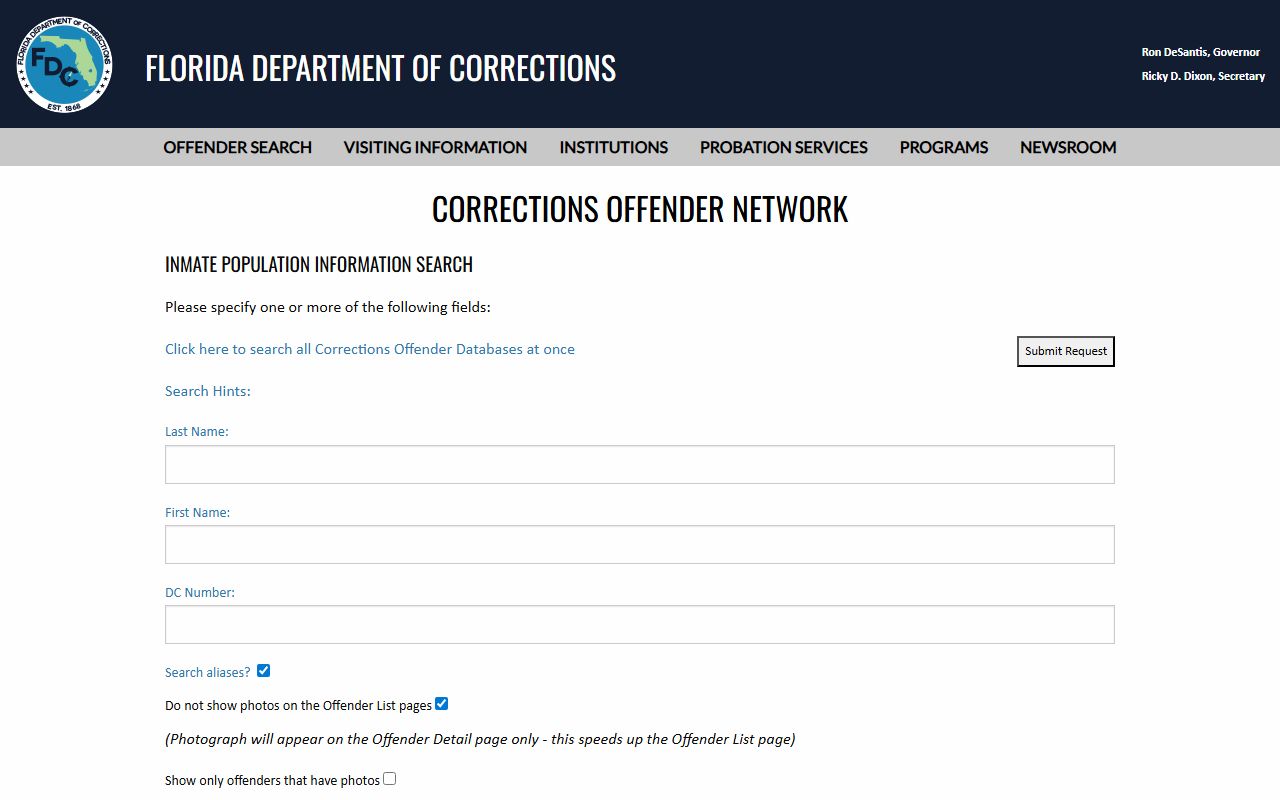
For a current county inmate, the jail roster and the jail phone line are the front door. For a sentenced inmate, the state locator is the right tool, and its search fields are public and documented. The table below shows the Florida Department of Corrections offender search fields, which is the system to use once a Marion County defendant has been transferred to prison.
| Field Label | Type | Required | Notes |
|---|---|---|---|
| Last Name | Text | One identifier needed | Search by name path |
| First Name | Text | No | Narrows a name search |
| DC Number | Text | One identifier needed | Direct Florida DOC number |
| Search Aliases | Option | No | Includes known aliases |
| Photo filtering | Option | No | Filters results that include a photo |
The county jail roster fields could not be verified during research because the portal blocked automated access, so this site does not publish a made-up county field list. Use the jail phone line when the online roster will not return a name.
What a Marion County Inmate Record Shows
A county booking record starts when the jail's Booking Unit processes a new arrival, and the Classification Unit then adds housing, release dates, and other detail. For a sentenced inmate, the state offender profile is the public record people most often read, and its fields are documented. The inventory below is the FDC offender profile, used for people who have moved from the Marion County jail into state prison.
| Field | What It Shows |
|---|---|
| Name and DC Number | The inmate's name and Florida DOC number. |
| Photograph | A current corrections photo when one is on file. |
| Offense | The current offense or offense history. |
| Location | The current prison or custody location. |
| Sentence | Sentence length and history. |
| Release Date | The current release date, subject to recalculation. |
A state profile does not show bond, because a sentenced prisoner is past the bond stage. For booking-level detail on a county inmate that is not online, a public-records request to the Sheriff's Records Unit is the documented route.
Past and Released Inmate Records
Finding someone who is no longer in custody works differently. A county jail roster generally lists people who are in the jail now, so a released or transferred person may drop off. When that happens, the documented fallback is a public-records request to the Sheriff's Office for booking or arrest records, or a check of the state locator if the person was sentenced to prison.
Do not assume a person is free just because the jail search does not return them. They may have been moved to state custody, picked up on a federal hold, or never booked into the Marion County jail at all. The court case may also still exist even when custody has ended, which is where the clerk's court records come in.
County Jail vs. State Prison: Where to Look
The single most common mistake in a Marion County inmate search is using the wrong system. Pretrial detainees and short-sentence inmates sit in the county jail and show on the Sheriff's roster. Sentenced felons move to a Florida Department of Corrections prison and show in the state locator. The table sorts out which tool covers which part of the population.
| County Jail | State Prison (DOC) | |
|---|---|---|
| Who Is Held | Pretrial plus short county sentences | Sentenced felons |
| Run By | Marion County Sheriff's Office | Florida Department of Corrections (FDC) |
| Where to Look | County jail roster / jail phone line | FDC offender locator |
| Stays Listed | While in county custody | Through the prison sentence |
One quick rule: A booking shows on the county jail side within hours of arrest, but once a person is sentenced and transferred, the state offender locator becomes the correct tool and the county roster will no longer list them.
State and Federal Inmate Search
Beyond the county jail, three official locators cover the rest of the inmate population. The FDC offender search covers sentenced state prisoners. The Federal Bureau of Prisons locator covers sentenced federal inmates from 1982 to the present. The ICE Online Detainee Locator covers immigration detention. No BOP prison or ICE facility was found inside Marion County, but a county arrest can still involve a U.S. Marshals hold or an ICE detainer.
The state offender search form is shown below; it is the tool for anyone who has left the county jail for a Florida prison.
For custody-status alerts rather than a full profile, VINELink Florida can send notifications, though it does not replace the official roster or locator.
- Pretrial detainee
- Someone held before their case is resolved, who has not been convicted.
- Sentenced inmate
- Someone serving time after a conviction or plea.
- Detainer
- A hold placed by another agency that can keep a person in custody even after local release.
- Classification
- The jail process that assigns custody level and housing.
Marion County Detention Facilities
The Marion County inmate population is spread across one county jail and four state prisons, all in or near Ocala. Each facility page explains who is held there and how to look them up.
- Marion County Jail - The county jail for pretrial detainees, short-sentence inmates, and people awaiting transfer.
- Lowell Correctional Institution - A state prison for female adult and youthful offenders.
- Lowell Annex - A state prison annex for female adult inmates.
- Florida Women's Reception Center - A multiple-mission state reception facility for women.
- Marion Correctional Institution - A state prison for male adult inmates.
Marion Correctional Institution and the Marion County Jail are easy to confuse because both carry the county name and both sit in Ocala. They are different facilities, run by different agencies, with different lookup tools.
Marion County Inmate Population FAQ
How big is the Marion County inmate population?
The Marion County Jail had an average daily population of 1,822 in 2024 against a rated capacity of 1,924 beds, with a peak of 1,922 that year, according to the Sheriff's Detention Bureau Annual Report. Monthly state reports later showed lower counts, 1,604 in March 2025 and 1,430 in October 2025. Thousands more from the county are held in the four state prisons inside Marion County.
How do I search the Marion County inmate population?
Start at the Sheriff's official inmate search, which routes to the jail roster, and search by last name. If the portal will not load or the person is not listed, call the jail at 352-351-8077. If the person was sentenced, use the Florida Department of Corrections offender locator instead, since sentenced prisoners are not on the county roster.
Can I look up a released or past inmate?
A county roster generally lists current inmates, so a released or transferred person may not appear. File a public-records request with the Sheriff's Records Unit for booking or arrest records, and check the state locator if the person went to prison. The court case may still be searchable through the clerk even after custody ends.
How much of the jail is pretrial?
State county detention reports show more than half the Marion County Jail population is pretrial, 55.7 percent in March 2025 and 54.9 percent in October 2025. Pretrial means the person is held while the case is pending and has not been convicted.
Why are there state prisons in Marion County?
Florida operates four corrections facilities in the county: Lowell Correctional Institution, Lowell Annex, the Florida Women's Reception Center, and Marion Correctional Institution. They hold sentenced state prisoners, not ordinary county detainees, and are searched through the state locator rather than the county jail roster.
Is the jail population data public?
Yes. Florida public-records law opens state, county, and municipal records, including jail and booking data, to inspection by any person, subject to specific exemptions. The jail also operates under the Florida Model Jail Standards, which set minimum conditions and require inspections.