
Marion County Court Records After a Jail Arrest
When someone is arrested and booked into the Marion County Jail, the booking creates a jail record, but it does not by itself create a court case. The court record opens when the Fifth Judicial Circuit State Attorney reviews the arrest and files charges, or declines to. From that point the case is tracked by the Marion County Clerk of Court and Comptroller, which keeps the official index of charges, hearings, and outcomes. So the court records that follow an arrest live with the clerk, while the decision about what to charge belongs to the prosecutor.
The booking side and the court side answer different questions. For the roster, custody status, and booking detail, see jail inmate records, and for booking photos see jail roster mugshots. This page stays on the court record itself, the charges the prosecutor filed and how to read them as the case moves. The booking charges an officer lists at the jail are not always the charges that end up in the court file.
How to Find Marion County Court Records After an Arrest
Marion County court records are searched through the Clerk of Court's remote viewing system, which routes to the Civitek OCRS portal for the county. Public users get an anonymous tier, while attorneys, registered users, and parties log in for more. The clerk's portal warns that what you see online is informational and not a certified record, so certified copies still come from the clerk's office.
- Open the Marion County OCRS court portal and choose the public access tier.
- Search by defendant name on the person tab, or by case number on the case tab.
- Open the case and read the charge list, party names, dockets, and events.
- Check each charge for its code, level, and current status.
Name search is easiest for families who only have a person's name, while case-number search works once you have a citation, docket, warrant, or clerk notice that gives the year, court type, and sequence number. For a statewide criminal-history record, Florida limits dissemination under section 943.053, so a formal history comes through FDLE rather than a casual portal search. The OCRS search portal and its access tiers are shown below.
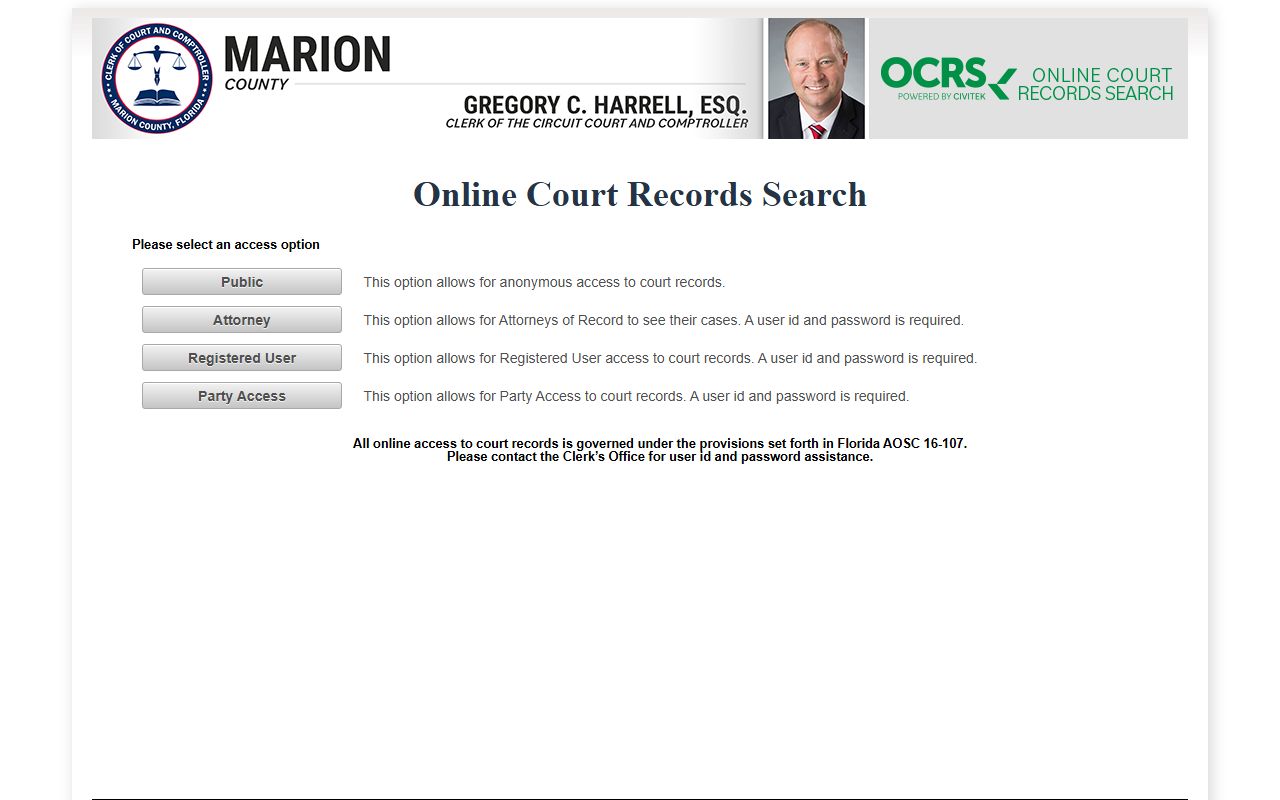
The public tier is enough for a basic name or case search, which is how most people pull court records after an arrest without an account. Online access in Florida is role based and governed by the Supreme Court order AOSC16-107, which is why an attorney, a party, or a registered user can see more than an anonymous member of the public. The portal also warns that documents may be delayed after filing and that some are limited by role, so the clerk's office remains the source for anything the public tier will not show.
| Field Label | Type | Required | Notes |
|---|---|---|---|
| Last Name | Text | Yes for person search | Last name required on the person tab |
| First Name / MI | Text | No | Narrows a person search |
| Date Case Filed (From / To) | Date | No | Optional date-range filter |
| Court Type | Checkboxes | No | Felony (CF), Misdemeanor (MM), Criminal Traffic (CT), and more |
| Year / Court Type / Sequence | Text | Yes for case search | The three parts of a case-number search |
How Charges Get Filed After an Arrest: Complaint, Information, and Indictment
The court record starts with a charging document. Booking happens at the jail, then the case begins when a charge is filed. In Florida most misdemeanors and many felonies are filed by the prosecutor through an information, while the most serious felonies can be presented to a grand jury, which returns an indictment. A complaint or affidavit from the arrest can start the process, but the prosecutor's filing is what frames the court charges.
| Complaint | Information | Indictment | |
|---|---|---|---|
| Filed By | Officer / Prosecutor | Prosecutor | Grand Jury |
| Common For | Initial arrest charges | Many felonies and misdemeanors | The most serious felonies |
| Starts | The intake process | The court case | The court case |
The Fifth Judicial Circuit State Attorney is the office that makes this call for Marion County, and it can file, amend, reduce, or decline the counts an officer listed at booking.
Charge Status in the Court Record
Charges change as a case moves. The prosecutor may add, amend, reduce, or drop counts, and the court may dismiss them, so the booking charges on the jail roster can differ from the charges in the final court file. The common status terms below show up across Marion County criminal cases.
| Status | What It Means |
|---|---|
| Pending | The charge is unresolved and the case is still moving. |
| Amended / Reduced | The charge was changed or lowered to a lesser offense or level. |
| Dismissed | The court or prosecution ended the count. |
| Nolle Prosequi | The prosecutor chose not to proceed with the charge. |
A charge is not a conviction. The court record only shows a conviction when it lists an adjudication or disposition that says so.
Bond and Release After an Arrest
Bond is usually addressed at first appearance soon after booking. The Marion County Jail accepts bonds 24 hours a day once booking and identification are complete, and release after bond can still take several hours because of internal checks. A hold or detainer from a court or another agency can keep a person in custody even after a bond is posted.
| Bond Type | How It Works |
|---|---|
| Cash Bond | Paid in full by cash or certified bank check at the Jail Information and Visitation Center. |
| Surety Bond | Posted through a licensed bail bonding agent; the Sheriff's Office cannot recommend one. |
| Debit / Credit Cash Bond | Available through a card service the Sheriff lists, with fees outside the agency's control. |
| No-Bond Hold | A court or agency hold that bond alone will not clear. |
Formal bond amounts and hearing dates are part of the court record, so the clerk's portal is the place to confirm them rather than the booking paperwork.
Warrants That Lead to an Arrest
Many arrests start with a warrant. An outstanding warrant can result in a booking, and a bench warrant for a missed court date can show up as an event in the case file. The Sheriff's Office sends warrant questions to its Warrants Division at 352-369-6746 and points the public to the FDLE wanted-persons search for active warrant checks.
The FDLE wanted-persons search is updated from state crime files every 24 hours, and a hit there is not proof a warrant is still active, so it should be verified with the reporting agency. Once a person is arrested on the warrant and booked, the jail roster and the court file become the better sources, and a records request to the Sheriff covers warrant or arrest records it holds.
Charges vs. Convictions
Being arrested and charged is not the same as being convicted. A charge is an accusation that only needs probable cause, while a conviction requires proof beyond a reasonable doubt through a verdict or a plea. Both stages are public record, but they mean very different things.
| Charge | Conviction | |
|---|---|---|
| Stage | Accusation | Verdict or plea |
| Burden of Proof | Probable cause | Beyond a reasonable doubt |
| Public Record | Yes | Yes |
Reading a court file carefully matters here, because a dismissed or reduced charge can sit in the same record as the original booking charge.
Sealed vs. Expunged Arrest Records
Florida lets eligible people seal or expunge a record after a dismissal or an eligible outcome, but it is not automatic. Sealing and expunction generally require an eligibility certificate from FDLE before a court petition, under sections 943.059 and 943.0585. Sealing hides a record from most public view; expunction goes further and treats the record as destroyed.
| Sealed | Expunged | |
|---|---|---|
| Visibility | Hidden from public view | Destroyed or treated as never existing |
| Law Enforcement | Limited access | Very limited access |
| Eligibility | FDLE certificate, then court petition (§ 943.059) | FDLE certificate, then court petition (§ 943.0585) |
Sealing or expunging a court record does not force every private website to delete a copy it already posted, which is a separate issue from the official record.
Background Check Considerations
Court records pulled casually online are not the same as a regulated background check. A formal background screening for employment, housing, credit, or insurance is governed by the federal Fair Credit Reporting Act and must come from a compliant consumer reporting agency, not from a public-records lookup. The state attorney homepage below is the office that handles the prosecution side of these records.

Important: This is a private reference site and not an FCRA consumer reporting agency, so nothing here may be used for employment, tenant, credit, or insurance screening.
Restricted Court Records After an Arrest in Marion County
Not every record tied to an arrest is open online. Juvenile information obtained under Chapter 985 is largely confidential under section 985.04, sealed and expunged matters are restricted, and some document images in the clerk's portal are marked view on request, meaning the clerk reviews them for redaction before they can be opened. Ongoing investigations and certain victim or personal details can also be withheld or redacted under the public-records exemptions in section 119.071.
For older records, certified copies, or documents not posted online, the clerk's public-records process is the route, and prosecutor files come from the State Attorney's public-records request rather than the clerk. The clerk's office is at 110 NW 1st Ave., Ocala, FL 34475, reachable at 352-671-5604, open Monday through Friday.